
REVIEW · JERUSALEM CITY TOURS
7-Hour Jerusalem Political Guided Tour from Jerusalem
Jerusalem politics hits different on foot. This 7-hour guided day from Green Olive Tours puts the Israeli-Palestinian conflict into plain language, starting with a tight history of the Old City from the late Ottoman period to today. I especially liked the way you get a timeline you can actually hold in your head, not just a list of sights.
My second big win was how the tour connects sacred space to real geography. You walk through the Old City markets toward the Western Wall Plaza, then you get the conflict context around the Temple Mount and Al Aqsa. Later, the drive gives you a clear comparison between West Jerusalem and East Jerusalem from real lookout points.
One drawback to consider: this tour is for people who want politics and conflict explained, not purely for scenery. Also, the schedule includes time for lunch but lunch is not included, and the day calls for moderate physical fitness because you will be walking in the Old City.
In This Review
- Key points before you go
- First stop: Antar Ben Shaddad, then a 9:00 am political briefing engine
- Old City of Jerusalem: the late Ottoman timeline and the holy basin context
- Through Damascus Gate markets to the Western Wall Plaza and Temple Mount context
- After lunch time: driving East Jerusalem neighborhoods and the West Jerusalem skyline
- The West Bank wall: the Separation Barrier and the security plus surveillance story
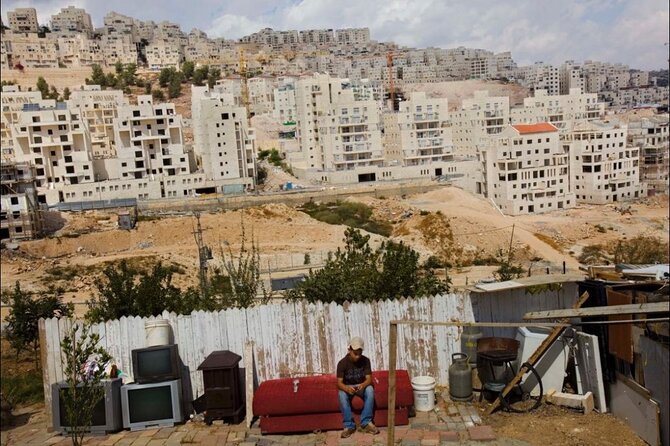
- Ma’aleh Adumim, Anata, and E1: seeing claims and planning on the same horizon
- Is $199 good value for a 7-hour political day in a small group?
- Who should book this tour, and who might want to choose something else
- Should you book the Green Olive Tours Jerusalem political tour?
- FAQ
- How long is the Jerusalem Political Guided Tour?
- How much does the tour cost?
- Where do I meet, and what time does the tour start?
- What is included in the price?
- Is lunch included?
- What is the maximum group size?
- Is there a physical fitness requirement?
- What is the cancellation policy?
Key points before you go
- A Palestinian-nationalist framing that tries to move beyond us vs them talking points.
- Old City history briefing running from late Ottoman times to the present.
- Damascus Gate to Western Wall Plaza walk, including the context of Mugrabe neighborhood.
- East-West comparison from lookout points and the seam line road views.
- West Bank barrier, also called the Separation Barrier, with the stated security and surveillance angle.
- Anata, Ma’aleh Adumim, and E1 stop with geography you can picture on a map.
More of Jerusalem, beyond the Old City gates
First stop: Antar Ben Shaddad, then a 9:00 am political briefing engine
The day starts at the Jerusalem Hotel Antar Ben Shaddad at 9:00 am, and the tour ends back at the same meeting point. It runs about 7 hours, and the group stays small, with a maximum of 16 people. That size matters here. When the content gets tense, you want a format where questions can land and the guide can keep moving at a human pace.
You’ll be in an air-conditioned vehicle for the driving segments, which helps because you are moving between very different areas of Jerusalem and the West Bank. You also get a mobile ticket, so it is less fiddly on the day.
This tour is designed to do more than explain events. It gives you a structure for understanding why certain places are contested, why certain neighborhoods were changed, and why lines on the map turn into barriers on the ground. If you are the type who wants to connect headlines to real streets, this format works well.
Old City of Jerusalem: the late Ottoman timeline and the holy basin context
The first major block is the Old City of Jerusalem. You get a detailed briefing right away, covering roughly 100 years of history, from the late Ottoman period through what came after. That’s not trivia. It helps you see the Old City as something that has been administratively reshaped over time, not frozen in time like a postcard.
You also get an introduction to Israeli occupation and settlement efforts connected to the Old City and the nearby Holy Basin. In practice, that means your guide will point out visible signs of presence and control, and connect them to what those signs have meant historically and politically. If you come to Jerusalem only thinking of it as holy sites, this portion forces a harder question: holy places still sit inside power arrangements.
The morning tour also focuses on the Old City’s central role to the three monotheistic religions. Then the walk loops back to the visible icons of Israeli occupation in the Christian Quarter and Muslim Quarter. The point is to show that religion is not separate from governance here. When you learn the history of where people live, study, or build, the Old City stops being only about architecture and becomes about claims, access, and boundaries.
How you might experience it: you will be listening and orienting yourself at the same time. The Old City can be disorienting for first-timers, so this guided start is valuable. It gives you mental handles before you start noticing details on your own.
Through Damascus Gate markets to the Western Wall Plaza and Temple Mount context
After the initial Old City briefing, the tour shifts into a walking segment that enters through Damascus Gate. From there, you move through the markets, and the guide helps you learn the city’s division. That is an important word choice: division is not just political theory. It shows up in who controls which streets, which entrances matter, and how movement can feel different block by block.
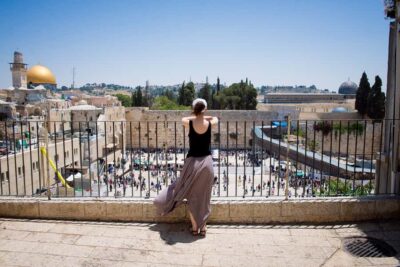
Next comes the Western Wall Plaza, which sits in the core of the Old City. You’ll learn that this plaza was created over the site of the destroyed Mugrabe neighborhood after the 1967 war. This is one of those details that changes the way you look at a place instantly. It is not only a religious destination. It is also a built artifact of post-1967 changes to neighborhood geography.
The guide also addresses the holiness of the Temple Mount in Judaism and the holiness of Al Aqsa in Islam, and why both are central to the conflict. You do not need to be an expert on either tradition to benefit, because the tour’s job is to connect the sacred to the political. When you understand why these sites symbolize competing narratives, the emotional charge of Jerusalem becomes more legible.
A practical note: you are walking and listening at the same time in a crowded, sensory environment. Give yourself room for patience and for fatigue. This is the kind of day where you will want breaks, even if they are small.
Other guided days in Israel


After lunch time: driving East Jerusalem neighborhoods and the West Jerusalem skyline
There is time in the schedule for lunch, but lunch is not included. The tour then includes another short briefing and a vehicle ride that teaches you the facts while driving through East Jerusalem settlements and Palestinian neighborhoods. This part is where a lot of first-timers go from abstract maps to something they can picture in three dimensions.
Lookout points are central here. The guide points out distinct differences between East and West Jerusalem, including modern office towers and highways in the West, versus unsealed roads and donkeys being ridden in the East. Those are stark contrasts, and they work as visual shorthand for how investment, infrastructure, and daily life can diverge.
You also get panoramic views back toward the Old City. That matters because you start to see how the Old City sits like a gravitational center, while modern development and political control wrap around it.
Then the tour goes down the seam line road that divides East and West Jerusalem. The idea is to show how a line on a map becomes a lived border. You’ll pass areas that were conquered, and the guide frames what those territorial changes mean on the ground. Even if you already know basic terms, the drive helps you understand why people describe Jerusalem with words like fragmentation, adjacency, and separation.
One consideration: this section is driving and looking. If you hate being stuck in a van for long stretches, you might prefer a tour that focuses only on walking. If you like context and comparison, you will probably find the views worth it.
The West Bank wall: the Separation Barrier and the security plus surveillance story
Next comes an up-close look at the infamous wall, sometimes called the Separation Barrier. The tour frames it as dividing not only Arabs and Jews, but in many places also dividing Palestinian communities. That is a key point. Even when people talk about security, the lived result often includes family separation, access problems, and different patterns of daily travel.
You’ll learn the reasons the wall was built, and how the guide explains its effectiveness at preventing terrorism. The tour also talks about surveillance of Palestinian residents. This is where the tour’s political stance becomes very clear. You are not just hearing that a barrier exists, you are hearing the arguments that are used to justify it and the consequences that come with it.
As a visitor, you should be prepared for discomfort. The wall can feel like a blunt answer to a complex situation. The value of a guided approach is that you get the logic people use to defend the policy, plus the way the policy affects the people living next to it.
If you want to stay grounded during this stop, focus on what you can actually observe, then listen for how the guide connects those observations to policy. The goal is not to win an argument in your head. It is to understand how real-world systems produce real outcomes.
Ma’aleh Adumim, Anata, and E1: seeing claims and planning on the same horizon
The final stop moves you toward Palestinian village life impacted by the barrier. You’ll look at the Palestinian village of Anata, which is described as surrounded by the wall. From there, the tour talks about Ma’aleh Adumim, one of the biggest settlements in the West Bank, and you may visit outlying outposts of the town.
This section also covers displacement of the local Jahalin Bedouin, linking settlement expansion to changes in where people can live and move. You will likely find this part emotionally direct, because it moves from high-level political debates to specific communities named in the narrative.
The views help connect everything. Some lookout points include the Judean Desert and the E1 planning zone, described as an area set to be filled with new settlement neighborhoods and tourist hotels. Whether you agree with the policy or not, naming what is planned helps you understand why this is treated as a long-term, structural issue rather than a temporary conflict.
The bigger takeaway: by the end of the day, you stop thinking of Jerusalem as only holy sites plus headlines. You see it as a place shaped by planning decisions, settlement expansion, and physical barriers that redefine how people relate to land.
Is $199 good value for a 7-hour political day in a small group?
At $199 per person for about 7 hours, you are paying for three things: guide time, transport, and multiple high-stakes briefing stops. The tour also includes an air-conditioned vehicle, and admission tickets are listed as free for the key stops. That matters, because the day is structured around places where you benefit from expert framing.
Lunch is not included, so you should budget for food separately. Also, the day is designed to be a focused political education. If what you want is a casual walk and photos, the cost might feel high. If what you want is clarity on the conflict, and you prefer learning with a guide who has an in-depth grasp of the issues and an alternative perspective, the value can feel quite reasonable.
I like that the group stays under 16. In a small-group political tour, you are less likely to get rushed through critical explanations. You also have a better chance of hearing the guide respond to questions that come up organically.
Who should book this tour, and who might want to choose something else
Book this if you want a structured way to understand the conflict that goes beyond generic storytelling. This tour is built for people interested in expanding their knowledge of the conflict between Israelis and Palestinians, learning from a guide with in-depth knowledge and an alternative perspective.
You will probably enjoy it most if you:
- like walking Old City areas with context, not just photo stops
- want to connect sacred sites to the political geography around them
- prefer seeing the East-West differences from real viewpoints
- are ready to spend part of the day absorbing difficult material at places like the wall and settlement-adjacent areas
You might choose a different kind of tour if you:
- want primarily historical sightseeing with minimal political framing
- need a day with lunch included
- are not comfortable with walking in the Old City or with a moderate fitness pace
This is not about pretending the situation is simple. It is about giving you a map for the complexity.
Should you book the Green Olive Tours Jerusalem political tour?
I think this is a strong choice if your goal is understanding, not just seeing. The best part is the way the tour builds understanding step-by-step, starting with the Old City’s timeline, connecting sacred space to conflict, then moving through the seam line and ending at the barrier-linked settlement landscape around Anata and Ma’aleh Adumim.
If you are sensitive to emotional intensity, go in expecting that. If you want to come away with a clearer mental picture of geography, you are likely to feel satisfied after the 7 hours.
FAQ
How long is the Jerusalem Political Guided Tour?
The tour is approximately 7 hours.
How much does the tour cost?
It costs $199.00 per person.
Where do I meet, and what time does the tour start?
The tour starts at the Jerusalem Hotel Antar Ben Shaddad 15, Jerusalem, at 9:00 am.
What is included in the price?
The tour includes an air-conditioned vehicle. Admission tickets listed for the stops are free.
Is lunch included?
No, lunch is not included.
What is the maximum group size?
The tour has a maximum of 16 travelers.
Is there a physical fitness requirement?
Yes. Travelers should have a moderate physical fitness level.
What is the cancellation policy?
You can cancel for free up to 24 hours in advance of the experience’s start time for a full refund. Cancellation cut-off is based on the local time.
Other Tours We Have Reviewed in Israel
- From Jerusalem: Masada & Dead Sea Full Day Tour with Pick Up
★ 4.5 · 815 reviews - From Jerusalem: Nazareth and Sea of Galilee Tour
★ 4.5 · 588 reviews - From Jerusalem: Masada&Dead Sea Tour INCLUDING ENTRANCE FEES
★ 4.3 · 392 reviews - Jerusalem: Guided Walking Tour of the Old City
★ 4.7 · 386 reviews
More Israel Tour Reviews
- From Jerusalem: Masada & Dead Sea Full Day Tour with Pick Up
★ 4.5 · 815 reviews - Masada and the Dead Sea Day Trip from Jerusalem
★ 4.5 · 757 reviews - From Jerusalem: Nazareth and Sea of Galilee Tour
★ 4.5 · 588 reviews - Nazareth and the Sea of Galilee Day Trip from Jerusalem
★ 4.5 · 446 reviews
Jerusalem, Other Days Out
- Full Day City Tour of Jerusalem
★ 4.1 · 367 reviews - Old and New Jerusalem Full-Day Tour
★ 4.0 · 273 reviews - Jerusalem and Bethlehem Day Tour from Jerusalem
★ 4.5 · 258 reviews - Jerusalem Half-Day Sightseeing Tour
★ 3.9 · 177 reviews
Recently Added Israel Tour Reviews
- jerusalem classic tour★ 5.0 · 3 reviews
- Private Walking Tour in Jerusalem’s Old City★ 5.0 · 3 reviews
- Private Tour Bethlehem and the Dead Sea★ 5.0 · 3 reviews
- Jerusalem Temple Mount & Dome of the Rock★ 4.5 · 3 reviews
- Jerusalem and the Dead Sea★ 5.0 · 3 reviews
Jerusalem City Tours, compared.
 ★ 4.3From Tel Aviv: Jerusalem and Bethlehem Guided Day TripFrom $1181,316 reviews
 ★ 4.0Tel Aviv: Jerusalem, Bethlehem & Dead SeaFrom $109881 reviews
 ★ 4.5Day Tour to Jerusalem and Bethlehem from Tel AvivFrom $121720 reviews
 ★ 4.1Full Day City Tour of JerusalemFrom $75367 reviews
 ★ 4.5Old and New Jerusalem Day Trip from Tel AvivFrom $95296 reviews
 ★ 4.0Old and New Jerusalem Full-Day TourFrom $75273 reviews
 ★ 4.5Jerusalem and Bethlehem Day Tour from JerusalemFrom $106258 reviews
 ★ 3.9Jerusalem Half-Day Sightseeing TourFrom $50177 reviews
Lists this tour appears in