
REVIEW · THE NEGEV & RAMON CRATER
Stargazing Mitzpe Ramon
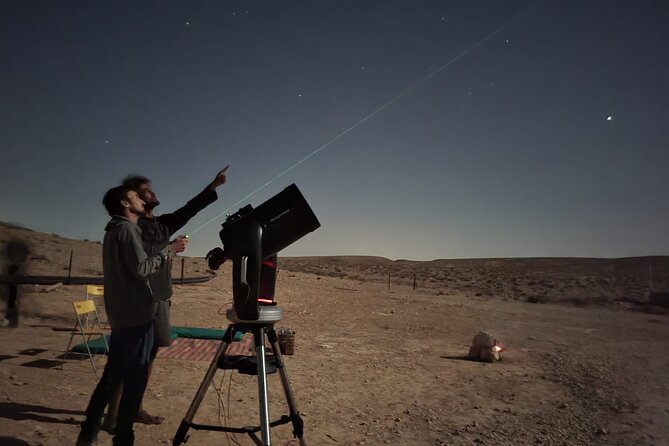
The desert turns the night into a classroom. At Stargazing Mitzpe Ramon near Makhtesh Ramon, you sit on mats and mattresses in an ultra-dark setting, then use advanced robotic telescopes to point your eyes at planets, the Moon, and deep-sky targets. I love the intimacy of the setup and the way the evening mixes relaxing comfort with real astronomy talk, from constellations to the history of sky myths. One heads-up, the desert can get cold once the sun drops, so bring warm layers.
What makes this experience feel special is how “low hassle” it is once you’re there. Your guide meets you at the crater area with the telescopes ready, and you’re taken through the sky step by step while a fire, tea or coffee, and snacks keep the mood easy. The only real drawback is that it is remote, and transportation to and from the meeting point is not included, so you’ll need to handle getting yourself there.
Because it’s private for your group, up to 8 people, the evening stays calm and focused. Guides like Nadav, Moshe, and Ori show up in past experiences for their warm, confident teaching, and that matters when the sky is dark and the targets are faint.
In This Review
- Key Highlights You Actually Care About
- Makhtesh Ramon Meeting Point, and Why the Timing Feels Simple
- What 1.5 to 2 Hours in the Desert Really Means
- Robotic Telescopes Point the Night Sky for You
- Constellations, Zodiac Signs, and Myths With Real Context
- Deep-Sky Targets: What You Might See, and How to Enjoy It
- Cozy Desert Comfort: Fire, Tea, Snacks, and Cold Weather Reality
- Your Guides: From Nadav and Moshe to Ori and Uri
- Price and Value: $460 Per Group for Up to 8
- Should You Book Stargazing Mitzpe Ramon?
- FAQ
- How long is the Stargazing Mitzpe Ramon experience?
- Where do we meet, and where does the tour end?
- Is transportation included?
- What is included in the experience?
- What can we see through the telescopes?
- Is it a private group?
- What happens if the weather is bad?
Key Highlights You Actually Care About
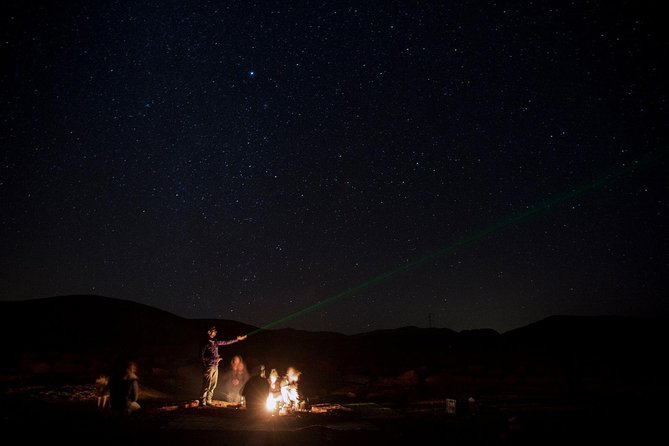
- Ultra-dark viewing at Makhtesh Ramon for clear constellations and Milky Way conditions
- Robotic telescope viewing for planets, the Moon, star clusters, nebulae, double stars, and galaxies
- Fire, tea or coffee, and snacks plus mattresses and mats so you can comfortably stay put
- A guided mix of stories and science (zodiac signs, myths, and solar system context)
- Small private groups up to 8 so you do not feel like you are fighting a crowd
Ramon Crater and the wider Negev, side by side
Makhtesh Ramon Meeting Point, and Why the Timing Feels Simple
You start at Makhtesh Ramon, also described as the Ramon crater area. The plan is straightforward: you get the exact location to arrive to on the morning of the same day, plus a scheduled hour for your session. That matters because the desert is big, and being given the right arrival spot helps you spend less energy guessing and more time looking up.
You also return to the same meeting point at the end. So you are not worrying about being stranded somewhere else or negotiating last rides after dark. If you prefer clear end-to-end flow, this setup fits that.
The session runs about 1 hour 45 minutes. The description also points to a 1.5 to 2 hour experience, which means your guide may flex the timing depending on sky conditions and how smoothly the telescope time goes. If weather is good, you get a full astronomy arc, not just quick peeks.
One more practical detail: you need a mobile ticket. That means no hunting for paper, but make sure your phone is charged enough for a nighttime arrival. Small thing, big difference when you are outside in low light.
What 1.5 to 2 Hours in the Desert Really Means
This experience is built around one core advantage, dark skies. You are taken to a remote, intimate location in the desert, where light pollution is limited. That is why you get the chance to see more than just bright stars. In many desert astronomy settings, the sky shows off layers, from clean zodiac constellations to faint deep-sky objects that you would miss in town.
During your session, your guide waits with the telescope and the viewing comfort gear. You are not standing for long periods. Instead, you lie down or sit back on mats and mattresses, which is honestly the difference between enjoying the night and getting stiff. The program includes a fire, and that warmth plus tea or coffee and snacks helps you stay relaxed through the time it takes your eyes to adjust.
The telescope portion is not a single moment. You use the telescopes to look at solar system targets like planets and the Moon, and then shift toward deeper objects such as star clusters, nebulae, double stars, and galaxies. That pacing matters. If you jump straight to deep-sky targets without any context, it can feel like the sky is just dark dots. Here, the guide keeps you oriented, so you understand what you are seeing.
Also, there is an “extended activity” option mentioned in the description. If your session includes extra telescope time, it usually helps you spend more minutes on the best targets instead of rushing.
Robotic Telescopes Point the Night Sky for You
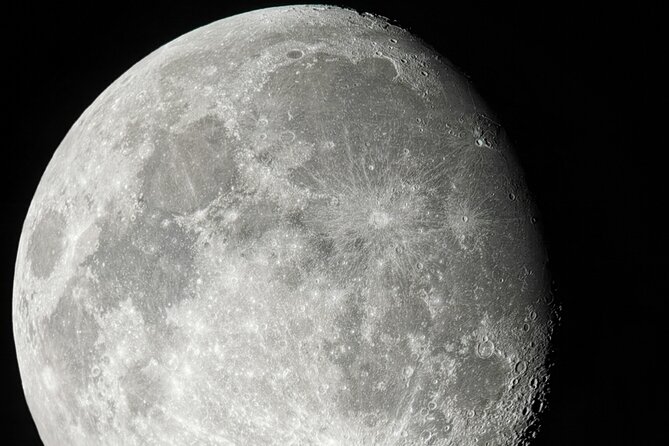
The standout tech here is the use of advanced robotic telescopes. For most people, that is the value. Even if you know how to find a constellation by eye, it can be hard to locate faint objects and keep them centered while your eyes adjust. A robotic setup gives you that precision, so the viewing time goes to what matters: the view itself.
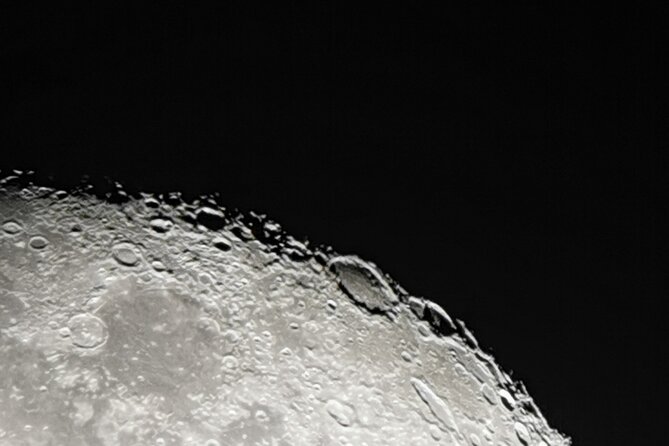
Your guide meets you with everything ready at the crater area. From there, you begin with the basics of the sky, using the telescope to connect what you hear with what you see. The description specifically calls out solar system planets and our own Moon. That is a great place to start because the targets are bright enough to feel rewarding fast.
Then you move to deeper sky objects, including:
- Star clusters
- Nebulae
- Double stars
- Galaxies
Even without getting technical, you can think of this as two levels of astronomy. The first level is about recognizable points of light with a lot of public-facing appeal. The second level is about faint targets that feel almost like spotting a whisper. Robotic telescopes help make those whispers visible.
One practical note: seeing results still depend on the night sky conditions. The experience requires good weather, and the provider indicates it can be canceled or changed if conditions are poor. So your best planning move is to book with a flexible mindset and check the sky forecast near your date.
Constellations, Zodiac Signs, and Myths With Real Context
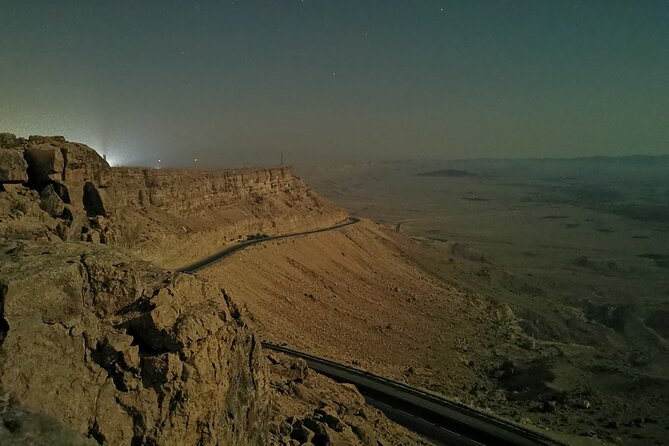
This is not just equipment time. You get a guided introduction to the night sky, including constellations, zodiac signs, and asterisms. You also hear stories tied to the sky, including myths and legends of the night. That mix is smart. Myths help your brain remember patterns, and then science gives you the why behind what you are seeing.
The guide also covers the history of astronomy and brings in scientific background about our solar system and beyond. You will likely notice that the explanations do not stay abstract. They connect to what the telescope shows you, so the talk becomes practical. When you can match the guide’s description to the view overhead, the whole night feels more like learning than entertainment.
The zodiac and asterisms piece is especially useful if you feel intimidated by astronomy. Instead of starting with a random star, you learn the shape language of the sky. Once you know a few key shapes, you start spotting them on your own, and that is when stargazing stops being something you just watch and starts being something you actively participate in.
Past guide names tied to strong experiences include Nadav, Moshe, and Uri (often mentioned with a Star Ori label). Those names matter because they suggest the guides focus on clarity and warmth, not just facts. If you want your evening to feel friendly and understandable, that is exactly the sweet spot.
Deep-Sky Targets: What You Might See, and How to Enjoy It
Deep-sky viewing is the main reason people book desert stargazing in the first place. You are going after objects that can be tiny, faint, or both. The description lists star clusters, nebulas, double stars, and galaxies. That lineup is a good spread, because each category teaches you something different about how the universe works.
Here is how to set expectations in a helpful way:
- Star clusters often look like small groups of points that feel more structured than random stars.
- Nebulae are the “clouds” of space where light takes a more complex route, so the view can be subtle.
- Double stars are fun because you get a clear before-and-after moment when you see two stars where your naked eye might see one.
- Galaxies are the hardest targets, but when conditions are good, they can be the most emotionally satisfying.
Comfort and patience matter here. Lying back helps, but your eyes also need time to adjust. The fire and warm drinks help you wait without feeling miserable. If you keep expecting dramatic fireworks, you might miss the slow magic. If you treat deep-sky viewing like a careful conversation with the sky, it clicks.
The experience is designed for that mindset. You are not dropped into a dark field and left with a telescope handle. You get guidance at each stage, so you know what to look for and why it looks the way it does.
Cozy Desert Comfort: Fire, Tea, Snacks, and Cold Weather Reality
Let’s talk comfort, because this experience clearly plans for it. Your guide brings a telescope plus mats and mattresses so you can comfortably lie down and watch the sky. That is a big quality-of-life detail. You can actually stay focused when your body is not fighting discomfort.
The setting also includes a fire, plus tea or coffee and snacks. That keeps the evening social without being loud. In a dark desert environment, a small break with something warm helps you stay present for the whole session, not just the first 15 minutes.
Yes, it can be cold. That comes through in prior experiences, where people noted the cold but still enjoyed the night because of the fire and the comfort setup. So my practical advice is simple: dress like you will be outside for a while. Bring warm layers, and consider gloves or a hat if you run cold.
One more comfort note: the experience is intimate, meaning you are not in a packed tourist line. With a private group, up to 8 people, you can spread out a bit around the fire and viewing area. That helps everyone see better and keeps the evening calm.
Your Guides: From Nadav and Moshe to Ori and Uri
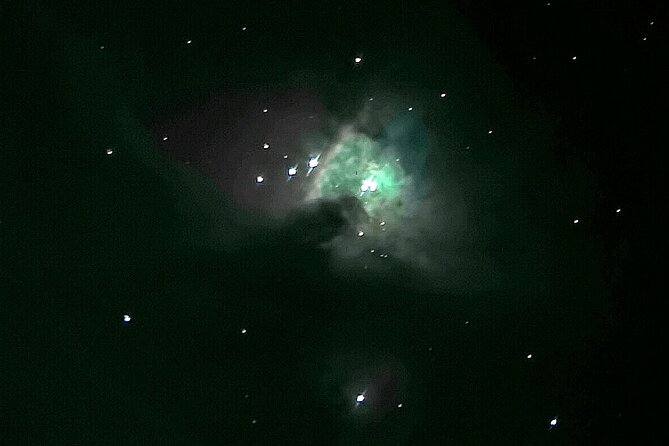
A good stargazing evening lives or dies by the guide. You want someone who can explain what you are seeing without sounding like a lecture. The strong experiences tied to this activity mention guides such as Nadav and Moshe, and also highlight Uri with a Star Ori mention.
What you should look for, based on these guide examples, is a balance of warmth and clear direction. In the dark, you need someone to orient you fast. Once you get your bearings, the rest of the night becomes much more fun.
The program also suggests the guide does more than point at objects. You get stories about the sky and links to history and science, plus zodiac and constellation talk. That combination helps you feel smart during the evening, not like you are just watching someone else’s hobby.
If you like astronomy but do not want to become a technical expert, you are in good shape. The goal is to make the universe above you feel understandable, not intimidating.
Price and Value: $460 Per Group for Up to 8
The price is listed as $460.00 per group, up to 8 people. That pricing can look high at first glance, but it can be good value because you are paying for a private night, remote guide work, and telescope support in a low-light environment.
Think of it this way. You are not paying per person for a quick show. You are paying for a guided session that includes:
- a local guide and professional guide
- robotic telescope time
- a full sky talk and targeting sequence
- fire, tea or coffee, and snacks
- a comfort-first setup with mats and mattresses
If you go as a smaller group, you may feel the per-person cost is steep. But if you can fill out the group up to 8, the value usually improves fast. This is the kind of activity that works well with friends or a small family group who enjoys learning and wants a quiet shared experience.
Also, the private setup can matter more at night than during the day. When people are lying down or trying to see through a telescope interface, crowding makes everything harder. A small group keeps it smoother.
If you are traveling solo, you might consider whether you can justify the price for a one-time, high-impact experience. If you are comfortable splitting costs with others, this is exactly the kind of night tour that tends to feel worth it.
Should You Book Stargazing Mitzpe Ramon?
Book it if you want a dark-sky experience with comfort built in and guidance that connects stories to what you see. This is especially a good fit if you like the idea of learning constellations, zodiac patterns, and deep-sky objects but you do not want to figure out telescopes and timing by yourself.
Skip it or adjust expectations if you hate cold weather. Even with a fire, you will be outside for about 1.5 to 2 hours. Bring warm layers, and plan to sit still and enjoy a slower pace.
Also, if getting to remote meeting points is a hassle for you, note that transportation to and from the attraction is not included. You will need your own plan for arrival.
In my view, this is a smart booking when you care about the quality of night viewing, not just checking off a sunset activity.
FAQ
How long is the Stargazing Mitzpe Ramon experience?
It lasts about 1 hour 45 minutes (approximately), and the description also frames it as a 1.5 to 2 hour experience.
Where do we meet, and where does the tour end?
You meet at Makhtesh Ramon (Ramon crater) and the activity ends back at the same meeting point.
Is transportation included?
No. Hotel pickup and transportation to and from the attraction are not included.
What is included in the experience?
The experience includes a local guide and a professional guide.
What can we see through the telescopes?
The description says you will look at solar system planets and the Moon, and also at deep-sky objects such as star clusters, nebulas, double stars, and galaxies.
Is it a private group?
Yes. It is private, and only your group participates. The group size is up to 8 people.
What happens if the weather is bad?
The experience requires good weather. If it is canceled due to poor weather, you will be offered a different date or a full refund. Confirmation is also subject to availability and received within 48 hours of booking.
More Israel Tour Reviews
- Rappelling Down the Ramon Crater Cliff
★ 5.0 · 47 reviews - Two hour guided jeep tour in to and around the Ramon crater
★ 5.0 · 45 reviews - Ramon Crater Jeep Tour from Mitzpe Ramon
★ 5.0 · 44 reviews - In Depth Introduction of the Ramon Crater
★ 5.0 · 11 reviews
The Negev and Ramon Crater, Continued
- Rappelling Down the Ramon Crater Cliff
★ 5.0 · 47 reviews - Two hour guided jeep tour in to and around the Ramon crater
★ 5.0 · 45 reviews - Ramon Crater Jeep Tour from Mitzpe Ramon
★ 5.0 · 44 reviews - In Depth Introduction of the Ramon Crater
★ 5.0 · 11 reviews
Recently Added Israel Tour Reviews
- The Ramon Crater and rappelling package tour – an exciting combo tour.★ 5.0 · 4 reviews
- Sunset time Ramon Crater Jeep tour, bonfire and stargazing★ 5.0 · 4 reviews
- Stargazing Mitzpe Ramon★ 5.0 · 6 reviews
- In Depth Introduction of the Ramon Crater★ 5.0 · 11 reviews
- Ramon Crater Jeep Tour from Mitzpe Ramon★ 5.0 · 44 reviews
The Negev & Ramon Crater, compared.
 ★ 5.0Rappelling Down the Ramon Crater CliffFrom $11547 reviews
 ★ 5.0Two hour guided jeep tour in to and around the Ramon craterFrom $27545 reviews
 ★ 5.0Ramon Crater Jeep Tour from Mitzpe RamonFrom $29544 reviews
 ★ 5.0In Depth Introduction of the Ramon CraterFrom $22511 reviews
 ★ 5.0Sunset time Ramon Crater Jeep tour, bonfire and stargazingFrom $5224 reviews
 ★ 5.0The Ramon Crater and rappelling package tour – an exciting combo tour.From $4254 reviews
 ★ 5.0GoKEDEM Private Negev & Ramon Crater Adventure From Tel Aviv With Bedouin FeastFrom $7394 reviews
Lists this tour appears in